#01
Project Architecture
How to structure a clean, production-ready codebase instead of running single-file scratch scripts.
Industry-Academic Incubation Program • THDC-IHET × Spiders Tech Services
Industry–Academic Incubation Program • THDC-IHET × Spiders Tech Services
Learn Python. Build Projects. Use GitHub. Think Like an Engineer.
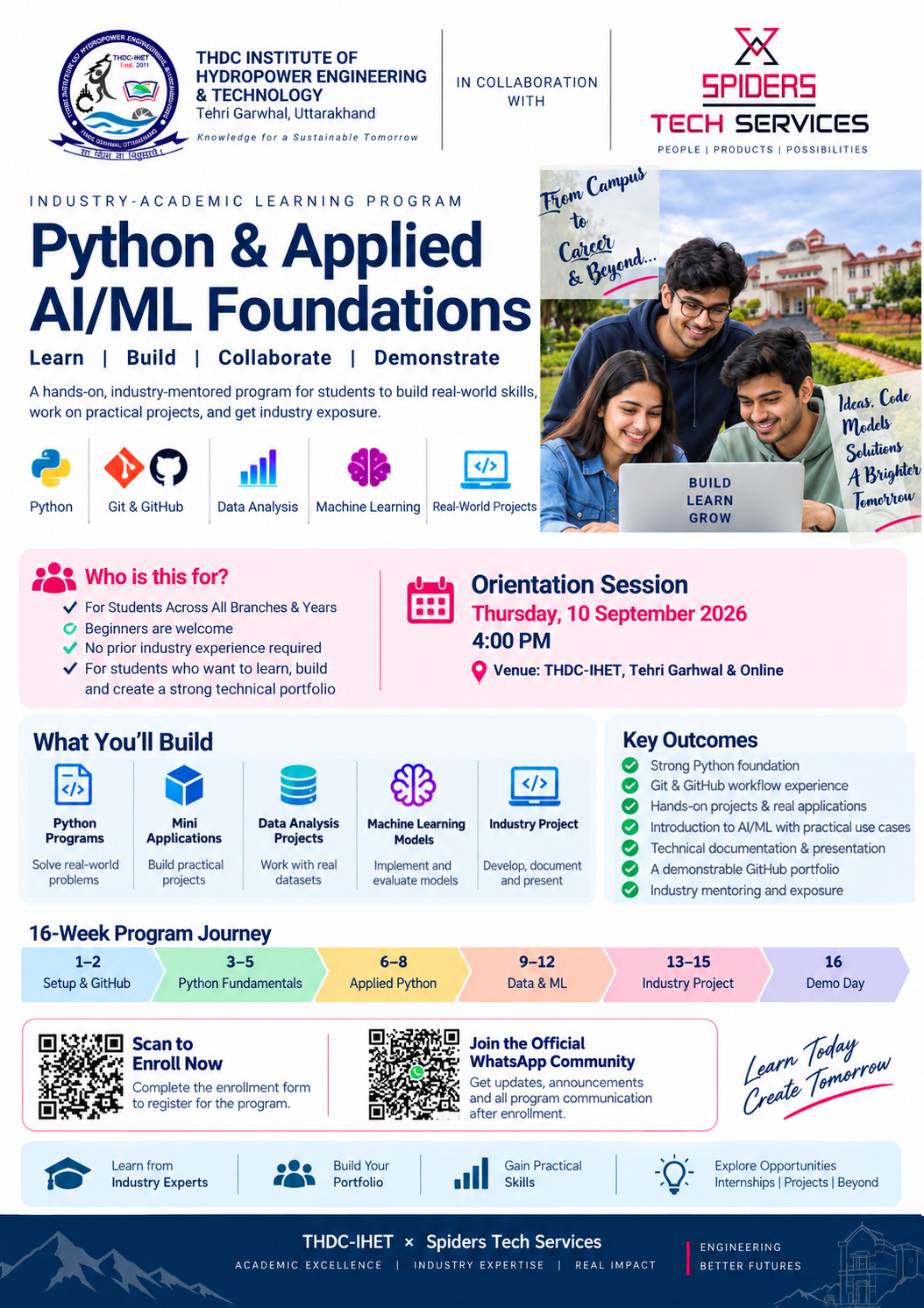
A beginner-friendly, industry-mentored program designed to help students (any branch & any year) move from learning Python syntax in a classroom to actually building, documenting, and managing real software projects on GitHub.
A student may memorize Python syntax and pass semester theory exams, but when faced with building an authentic production application or stepping into a tech internship, the gap becomes immediate.
How to structure a clean, production-ready codebase instead of running single-file scratch scripts.
How to make meaningful atomic commits, track history, and never lose code again.
How to manage remote repositories, issues, branches, and industry-standard Pull Requests.
How to receive constructive code critique, respond to comments, and perform collaborative refactoring.
How to trace stack traces, formulate hypotheses, and debug issues with developer tools.
How to navigate official library documentation and API specs rather than copy-pasting blindly.
Handling messy, real-world CSV/JSON datasets with missing values, noise, and schemas.
Understanding algorithmic trade-offs, time complexity, and choosing between heuristics vs. ML.
Crafting comprehensive READMEs, architectural diagrams, API contracts, and usage instructions.
Presenting technical solutions crisply to industry mentors and recruiters on Demo Day.
You will never sit passively through monologue lectures. You will progress through the identical cycle engineering teams follow at product companies:
▱ Recommended prerequisite: Access to a personal laptop for installing Python, Git, and running local code.
Three interconnected pillars engineered to transition you from writing isolated script snippets to architecting scalable, data-driven systems on GitHub.
From procedural logic to robust object-oriented software engineering.
The exact collaborative workflow utilized by top engineering companies.
Turn raw data into actionable insights and intelligent predictive systems.
No toy visual drag-and-drop. You will use VS Code / Cursor, Bash Terminal, Git CLI, GitHub Desktop & Web, NumPy, Pandas, Scikit-learn, and Markdown.
A structured, progressive incubation path engineered to take you from day-one fundamentals all the way to a public Demo Day presentation.
Understand program objectives, set up development environment, meet mentors.
Core programming confidence, algorithmic thinking, problem-solving.
Build working mini applications, file persistence, OOP, API integration.
Master industry version control, feature branches, pull requests & code review.
Work with real datasets, data cleaning, exploratory analysis, visualization.
Implement regression and classification algorithms with rigorous evaluation.
Engineer a complete real-world project, maintain GitHub repo, peer review.
Present and demonstrate working software to industry jury & faculty.
Target Outcome: Understand program objectives, set up development environment, meet mentors. Includes dedicated weekly mentoring touchpoints on Monday (Plan), Thursday (Debug), and Friday (Review).
Students won’t just complete lectures or follow canned tutorials. You will progressively build real, tangible software across 5 progressive stages.
Solve real-world computational problems. Build algorithms with clean modular separation and robust input validation.
Convert core Python skills into usable applications with file handling, reusable functions, structured modules, and simple user workflows.
Work with real datasets, clean inconsistent data, perform exploratory analysis, and present useful insights through simple visual outputs.
Train and evaluate beginner-friendly machine learning models using clean datasets, measurable metrics, and simple prediction workflows.
Build and present a complete project that combines Python, data handling, machine learning basics, GitHub workflow, and mentor review.
No more emailing zip files or coding in a vacuum. Every assignment, bug fix, and ML experiment passes through the exact 8-step lifecycle utilized at technology companies.
Every feature or bug starts as a tracked GitHub issue with acceptance criteria.
Create an isolated feature branch (Git checkout · feature/model-evaluation).
Implement clean, PEP8 compliant Python code with clear docstrings.
Make atomic commits with descriptive, professional commit messages.
Push your branch to GitHub remote repository (git push origin feature/...).
Open a descriptive PR referencing the issue with screenshots and test results.
Industry mentors and peers review lines of code, suggest enhancements.
Merge into main branch after approvals, automated tests, and verification.
“By the end of the program, students will develop and demonstrate a working Python application to solve a real-world problem using an appropriate algorithm or ML-based approach, maintain the project on GitHub, submit a Pull Request, participate in code review, and prepare technical documentation explaining the problem, approach, implementation, testing, and results.”
Complete, clean repository hosted publicly on your personal GitHub account.
Modular Python code with pytest test coverage and clean error handling.
Verifiable Pull Request history with mentor review feedback and iterations.
Architecture overview, installation guide, dataset provenance, and analysis report.
Live technical demonstration in front of faculty, peers, and industry panelists.
This needs to be 100% transparent before enrollment. Our industry mentors invest their time to review your code and guide you; here is what you must bring to the table:
You will be expected to learn, practice, build, commit, submit, receive feedback, and improve. If you are willing to invest consistent effort, you can finish the program with something far more valuable than a certificate — a demonstrable technical portfolio.
Presence and active participation are non-negotiable. Missing milestones breaks development momentum.
We do not measure progress by how many tutorials you watched, but by what code you wrote and verified.
Allocate 4–6 focused hours per week to code, experiment, break things, and rebuild.
No zip files, no email attachments. GitHub is your permanent proof of work.
Regular commits demonstrate authentic problem-solving and progressive refinement over time.
Never sit quietly when stuck. Learn how to ask high-quality technical questions with error logs.
Just like in the software industry, shipping on schedule is a vital professional discipline.
Give respectful code review feedback to peers and embrace constructive critique gracefully.
Write comprehensive READMEs detailing installation, architecture, dataset sources, and test outcomes.
Own your repository, your learning speed, your bug fixes, and your Demo Day outcomes.
Engineered to respect your academic timetable. 3 focused 30-minute touchpoints every week held after college hours to unblock you and keep your engineering velocity high.
Timing: 4:45 PM – 5:15 PM (Post College Hours)
Set clear goals for the week, understand the technical concepts, break down assignment requirements into GitHub issues, and align on deliverables.
Timing: 4:45 PM – 5:15 PM (Post College Hours)
Bring tough bugs, code blocks that refuse to work, Git conflicts, and data cleaning hurdles directly to mentors for screen-sharing and real-time guidance.
Timing: 4:45 PM – 5:15 PM (Post College Hours)
Review submitted Pull Requests, discuss mentor review comments, highlight exceptional implementations, and close the week with merged code.
The full calendar invitations, session links, and GitHub Classroom repositories will be shared inside the official student community immediately upon batch onboarding.
Get complete clarity on the 16-week journey, meet your industry mentors from Spiders Tech Services, and learn how to get your GitHub setup ready.
To ensure genuine mentorship quality and avoid casual drop-outs, we follow a vetted, step-by-step onboarding pipeline.
Understand objectives, curriculum & expectations
Join on Thursday, 10 Sept 2026 at 4:00 PM (Seminar Hall)
Submit roll number, branch, experience & motivation
Automatic reference ID generated + Mentor email notify
Faculty & mentor verification of student credentials
Secure, one-time invitation link sent to confirmed students
GitHub Classroom setup, dev environment verification
First weekly Plan touchpoint & procedural coding starts
Ready to participate in Program 01 — Python & Applied AI/ML Foundations? Fill out the form below. Submission instantly registers your seat and generates your confirmation for the controlled approval flow.